Top 10 books of 2012
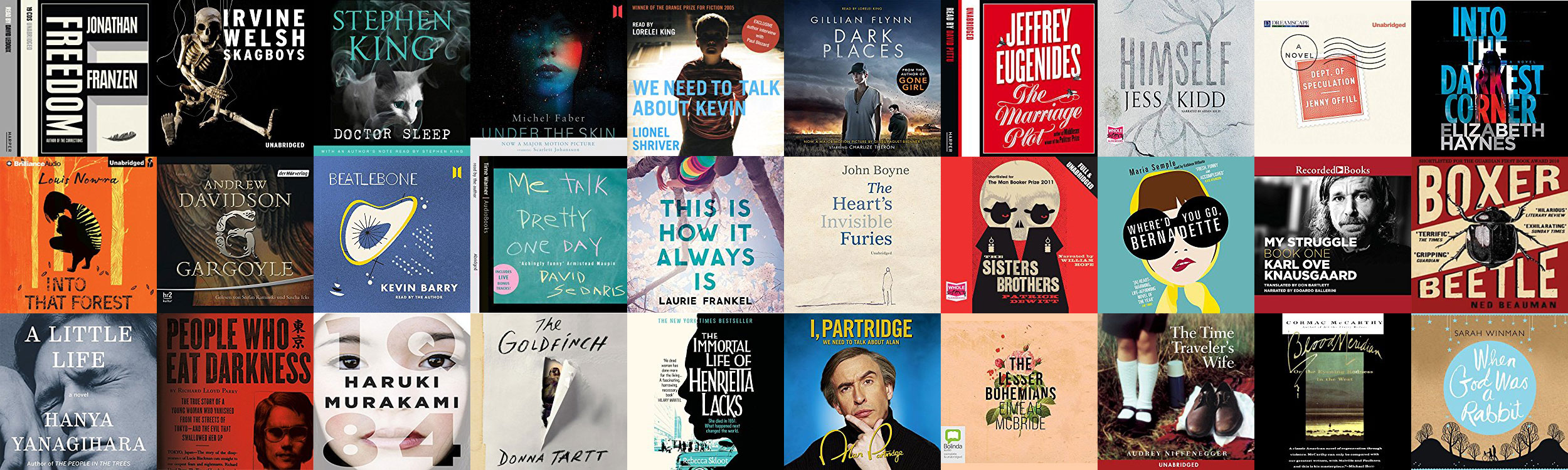
My top 10 books of the year. All audiobooks except for the Psychopath test. (Wow there’s not much between this post and last years top ten, I might just turn this into a book blog and be done with it)
10. Into the Darkest Corner I still want to find a thriller that genuinely thrills me but in general I find them really disappointing, clichéd, full of plot holes, and the biggest flaw in any genre for me: inauthentic. But this was definitely one of the better ones. Authethentic, plausible, and neither cliched nor disappointing.
9. Heft Arthur opp; an obese reclusive professor. Kel Keller: a promising baseball star. And Kel’s mother Charlene; the link between the two men. A small story, finely handled.
8. The Psychopath Test: A Journey Through the Madness Industry I’m still baffled by the clumsy start to this book but otherwise a fascinating dissection of what it really means to be a psychopath.
7. The Family Fang considering I’m a sucker for darkly comic dysfunctional families, how’s this for dysfunctional: “Child A” Annie and “Child B” Buster, serve as little more than the main props in their parent’s performance art. Unsurprisingly they have issues by the time they get to adulthood.
6. The Marriage Plot - A bit like One Day, except not shit. Actually it’s nothing like one day except that it pivots around a relationship. Recommended for fans of Franzen. They are quite similar.
5. Tell the Wolves I’m Home The thing about this book is that it’d be a great YA book. Though if it was marketed that way I never would have read it. The Hunger Games was a fun romp – but it had me rolling my eyes in lots of places where it was really dumbed down nonsense. If that’s YA I’m out. Tell the Wolves is mostly about a teenager struggling with loss, love and grief as well as the usual teenage stuff. But unlike The Hunger Games, it’s Rock Solid. No eye rolling.
4. 1Q84 - I’ve had a curious relationship with Murakami books, I wasn’t crazy about the first one but there’s something about his stories that just lure you back for more, and I’ve enjoyed each one more than the previous. But I also think 1Q84 is his most accomplished work, there’s a crazy logic in the alternate universe of 1Q84. It’s bit of a marmite book though, some people seem to hate it. I loved it.
3. People Who Eat Darkness: The Fate of Lucie Blackman True crime doesn’t get much better than this. There are so many fascinating strands to this story; the hostess culture in Japan, the exploration of how grieving parents are expected to act in the eye of the public, and of course the main crime itself involving the disappearance of Lucie Blackman
2. Skagboys Brilliant. As good as Trainspotting, if not better. No one does it better with this kind of stuff. It was like being back with a bunch of old friends. Even scumbags like Begbie… The problem is, he’s a mate n aw. What kin ye dae?
1. Where’d You Go, Bernadette Comedy is a funny thing(!) I usually find any books that are written for the comedy section anything but funny. I really didn’t like the comedy-book-of-the-moment “The 100 year old man who climbed out of the window”. But Where’d You Go, Bernadette was for me genuine laugh out loud funny as fuck.
I wish more books were like this. No long drawn out back story, or plodding character development. Just bam! Straight into it. A few pages in and there’s a whole world of hilarious stuff going on. This is one big passive aggressive note against the type of people who might write passive aggressive notes. Great fun, if a little far fetched in places, but it’s almost in sitcom territory, so we can give it some comedic licence. Highly recommended.
–
Honourable mention as I just finished it yesterday.
Yellow birds is an American soldier’s semi-autobiographical experience of the Iraq war. That conjures up a book that generally I would have little interest in but this boy sure can write. You can easily see why he’s being compared to the likes of Cormac McCarthy:
“Clouds spread out over the Atlantic like soiled linens on an unmade bed. I knew, watching them, that if any given moment a measurement could be made it would show how tentative was my mind’s mastery over my heart. Such small arrangements make a life, and though it’s hard to get close to saying what the heart is, it must at least be that which rushes to spill out of the parentheses which were the beginning and the end of my war: the old life disappearing into the dust … “
It’s in equal parts about the death of a friend and the death of his own youth, both killed in a senseless war. Brilliantly written.
Books of the (last) year
My favourite books of 2011. Better late than never, right?
10. Solace (novel / paperback)
Realistic & authentic characters and relationships. I like that.
09. A Monster Calls (novel / audiobook)
Surprisingly good for young adult fiction which I don’t (purposefully) read. It hit all the marks that Skippy Dies failed to. Great artwork in the paperback version (which you don’t get with the audio.)
08. At Home: A Short History of Private Life (Narrative Non-Fiction / audiobook)
Even though it’s not his best, I do love a good dose of Bill Bryson – a hotch potch collection of trivia, loosely connected to the rooms we live in.
07. The Help (novel / audiobook)
I was surprised to enjoy this so much, considering it has the whiff of an Oprah book club all over it. I think the performances of the Audiobook possibly helped, including Octavia Spencer, who won an Oscar for the same role in the Movie.
06. The Good, the Bad and the Multiplex (Narrative Non-Fiction / audiobook)
More Kermodian Rants. Amusingly this is like a collection of rants from the radio show fleshed out and written down. Actually I probably didn’t need to hear the “Sex and the City Rant” and the “3D rant” again, but lot’s more ranting besides.
05. Moonwalking with Einstein: The Art and Science of Remembering Everything (Narrative Non-Fiction / Kindle)
Joshua Foer’s highly amusing story of memory and mnemonics chronicling his discovery of and training for the World Memory Championship. Full review.
04. Squirrel Seeks Chipmunk: A Modest Bestiary (Fables / Kindle)
I loved this. Dark haunting animal fables. Or sometimes plain silly but hilarious animal fables. All in the inimitable style of my favourite essayist David Sedaris.
03. The Immortal Life of Henrietta Lacks (Narrative Non-Fiction / audiobook)
Perfect blend of intriguing characters, a history of cell culture, and a fascinating true story. A perfect piece of narrative non-fiction.
02. I, Partridge: We Need To Talk About Alan (Comedy Biog / audiobook)
The perfect audiobook. Could not imagine reading this on paper when I can listen to Steven Coogan in character. Seven hours of comedy gold.
01. When God Was a Rabbit (novel / audiobook)
I fell in love with this book within the first thirty pages, an adorable, slightly quirky story, about a girl called Elly and those she loves. I find it hard to separate the book from the audiobook in this instance. The audiobook was such a perfectly complete piece. It’s read by the author, Sarah Winman, with great warmth and perfect nuance already knowing and loving her characters so well. She has a fantastic voice both as a writer and narrator. I loved the cheeky voices of the children. Adult narrators often really over-do the chirpy voice thing, and ruin audiobooks that feature children.
Though the children are such adorable characters, you miss them when they’ve flown the coop, all too soon for my liking. Its hard not to be a bit disappointed when the book suddenly jumps to their adulthood. I wanted to stay immersed in the wonderful world of childhood that bit longer. But such is life. Like it or not, Adulthood comes knocking and Sarah Winman does her best to hold on to the things we hold dear from our formative years.
“And from that moment, I watched her. Watched her with different coloured eyes, until the raging energy that coursed through my body finally revealed itself and gave itself a name: envy. For I knew already that something had taken me from me, and had replaced itself with a desperate longing for a time before; a time before fear, a time before shame. And now that knowledge had a voice, and it was a voice that rose from the depths of my years and howled into the night sky like a wounded animal longing for home.”
It’s all too easy for novelists to make BIG things happen in their books. It’s too easy to give characters great luck, or bad luck, or great health or wealth or disease, or fame or fortune. I often wince when some authors use these tropes as easy plot devices but Sarah Winman hilariously turns that on it’s head and does it all! You could retitle it to When God Was A Novelist.
Adorable book. Book of the year. Audiobook of the year.
- – - – - – - – - – - – - – - – - – - – - – - – - – -
It wasn’t until I made this list that I realised just how much more I enjoyed non-fiction over the year. I’ve felt like this before; almost giving up on fiction in favour of non-fiction. I found a lot of novels a little bit… Meh. And there was something more to some of the non-fiction that I couldn’t quite put my finger on – until Jackie at Farm Lane Books drew my attention to a genre called Narrative Non Fiction. They’re non-fiction books but they usually have some kind of story arc, heroes, villians, a plot of sorts, an array of interesting characters and other devices derived from fiction.
Take the Immortal life of Henrietta lacks for example, a standard non-fiction version could be a relatively boring story about the history of cell research. But no, it’s a fascinating story about the Lacks family, and how Henrietta’s cells came to be used in every stem cell lab in the world. And the author is just as much a part of the story, another common Factor in Narrative Non-Fiction. See more examples on http://www.farmlanebooks.co.uk/2012/the-best-narrative-nonfiction/. I’ve created a goodreads shelf here with more additions.
- – - – - – - – - – - – - – - – - – - – - – - – - – -
Most Overated, and ultimately dissapointing books of the Year
One Day
Old Filth
Before I go to Sleep
Skippy Dies
More books
Yes I’m still hooked on audiobooks. Some more reviews:
Bill Bryson – Notes from a small Island
I’m not particularly interested in travel books but some folk are such entertaining writers that the content isn’t all that important. I’m sure I could read Charlie Brooker writing about the telephone book. Actually that’s a complete lie, I’ve skipped all the political stuff on his blog recently. But Bill Bryson waffling about his UK trips? I can sure enjoy that.
There’s a great balance in the book. Lot’s of ranting and raving about all the things that are shit about the UK, a lot of which are common to living in Ireland. Like the architectural rape of our cities in previous decades where monstrosities of buildings (Phibsborough shopping center?) were hideously erected, often in place of beautiful old buildings. But it’s also balanced with a great love for all the things that make the country great, peppered with the turn of phrase that makes Bill Bryson so laugh out loud funny.
The narrator’s posh English accent didn’t really work for me. Words like ‘Fuck’ just sounded wrong coming out of his mouth. Like he was spitting out something dirty. And some really ranty bits that were meant to be funny, just didn’t have the right kick, and made him sound like an asshole. Which he’s not, I imagined him cringing at some bits. But I got used to it after a chapter or two and most of it sounded fine. I’ve since noticed that Bryson narratesNeither here nor there himself, but I had a quick listen and the confidence in his writing doesn’t seem to carry in his voice. And nor should every writer need to sound like a professional narrator, obviously. So I guess it’s hard work trying to get the right narrator for any autobiographical work, unless read by the author.
Transition by Iain Banks. Narrated by Peter Kenny
I can’t easily pick favourites but I can easily say The Wasp Factory is my favourite book ever, and just as it was with Wasp Factory it was a bad review that drew me to Transition. Something about a sick joke. I like a bit of sick lit! But it turns out, you can indeed read too much of the one author. I think I’m done with Banksie now. As I’ve said before I was a total Banksie fanboy. I’ve read everything he’s written, and with that in mind, I found Transition quite repetitive and lazy. All the same themes I’ve read before too many times. He seems obsessed with big operations running the world, or the universe. Either rich families or secret organisations. There’s nothing new in Transition, it’s Quantum Leap with a thinly veiled Contact pulling the strings, as in Contact from all his Culture novels but in this book they’re called Concern. Contact/Concern, thin veil alright. And I feel like I’ve grown out of this type of science fiction for sure. I’d love to see Banksie getting back to the small personal books like Wasp Factory. No complaints on the audio end of things, all quite good readers.
Nick Hornby – Juliet Naked
Nick Hornby is really good at is writing good books that are very easy to read. No mean feat. And he’s great at nailing relationships, I found a lot of the relationship stuff close to the bone, and quite funny. And I can remember really enjoying it at the start but thought it lacked something overall. Couldn’t help thinking I was reading a screenplay rather than a book. Considering the main plot device resolves around people writing reviews on the Internet, the irony of this review wasn’t lost on me and I did enjoy the musings about good art, and who has the right to say what does and doesn’t make good art, the author? the fan? or the regular Joe?
The three narrators were good at playing themselves, but it fell apart when they had to quote each other, which is common in every book but sometimes problematic in audiobooks; the american actor putting on a British female voice and vice versa did not sound good. Or even (English) Annie quoting her husband Duncan, that sounded quite off; she gave him a personality transplant with a really silly voice. You could argue that’s how they perceived each other but it just sounded off to me. Though that’s a small point as it didn’t happen so often.
Audrey Niffenegger – The Time Travellers Wife
I loved this book. I found myself enjoying it from the start, but then halfway through, at a particular chapter I just thought “Wow – this is fantastic”. Niffenegger is a great writer, I kept noticing how she conveys so much with such short phrases; with just a few words you would know the exact look on a character’s face for example. And I really warmed to the characters, in a way which I don’t easily do.
I enjoyed the fact that you’d think it’d be a sci-fi novel but it’s really about a couple’s struggle to come to terms with a problem. Sure everyone has their problems, in their case it just so happens that Henry can’t stop travelling through time. And yes every sci-fi novel has a back story, but as someone who’s just grown sick of space operas this was a refreshing antithesis. The idea reminded me of one of my favourite novels, Middlesex by Jeffrey Euginedes, the fact that the main character is an hemaphrodite is irrelevant; it’s the coming of age story anyone could relate to that normalizes a freak affliction, just like the husband of the Time Traveller’s Wife. I miss reading it.
Mark Kermode – It’s Only a Movie
I’d actually intended to buy the paper version of this until I noticed it was narrated by Kermode himself. I just know that wouldn’t have worked with anyone else reading. Specially as I’m so used to hearing his voice on the Podcast. Unless it had been read by Jason Issacs, as that’s who Kermode casts as himself, in this story of his life through the eye of a movie. I loved this book too. I love Kermode’s passion for movies and he’s captured it perfectly. The excitement he describes seeing his favourite movies for the first time is contagious.
I thought one chapter, in Russia, dragged on a little, and was eagerly awaiting some more good stuff when it ended! So it is with an audiobook – if you’re not keeping an eye on the timer. A dissapointing ending *only* because I was enjoying it so much and it ended too soon. Highly recommended if you’re a Kermode fan or a movie nut.
Stieg Larsson – The Girl with the Dragon Tattoo
It’s a jolly good romp for sure. A classic modern daywhodunnit that I mostly enjoyed… but I dunno… I found the characters a bit unconvincing, the heroine is interesting yes, but just not quite authentic enough. Too many conflicting traits. And the plot just started to feel a bit contrived by the end. I enjoyed the fact that it was a classic locked room type mystery at the start, but I’m not sure I’m much of a whodunnit fan. The plot devices are just all too similar. Maybe a low jab, but I couldn’t help thinking it was similar to the DaVinci code, page turners yes I suppose, but lacking in character depth.
On the audio end of things, not for the first time did it take me some time to get used to an overly posh stage voice. I don’t mind posh voices. Quite like them but when you have to listen to a single voice for 16 hours, any strong accent, one way or the other, can be grating.
David Sedaris – Me talk pretty some day
I don’t think I’ve read a book of essays before. But I really liked it. I couldn’t help thinking each essay was similar to a blog post. But written by a high calibre blogger who knows his craft. Amusing stories from the life of Sedaris, told with flair and wit, both touching and funny. It inspired my Mi Padres esta Muerto post and similarly a lot of the tales in this book involved struggles with a foreign language, though much funnier in the hands of Sedaris. Amusing take to hear some of the chapters being read in front of an audience. A nice mash up of stand-up comedy and audiobook. It was a slightly different experience to hear every sentence punctuated with laughter, which made me laugh rather than smile at the funny bits. I discovered this book via the Books for ears site, which is the best audio book review site I’ve come across so far.
Kurt Vonnegut – Slaughterhouse 5
Ethan Hawke! Wake the fuck up. That’s what I wanted to scream. He narrated like an old granny reading a fairy tale. Oddly it sounded great at the start, and I like Nathan Hawke but it became unbearable very quickly. I almost didn’t persevere, and it put me off the actual book. Or maybe I just didn’t like the book all that much. I couldn’t decide. Apparently a very important book, but like a lot of important books it was probably important of the time, but didn’t strike me as such an important read in the context of now. Such is the peril reading from “books you must read before you die” type lists. I’m sure they were all brilliant at the time – but sometimes the time, place and political impact is what makes them so great, and don’t always work outside of that context.
Colum McCann – Let the Great World Spin
Everyone seemed to be talking about this all of a sudden. Not sure where I heard of it at first but soon after McCann was on Arts Lives, and he came across as a likeable fellow. Next day Radge was talking about him, and then I stumbled across the Irish Times Book Club doing let the Great World Spin. So that was the next read decided.
I often have a problem of not being able to decide if I like a book until I get to the end but I enjoyed this book as I read it, enjoying each moment for what it was rather than waiting to see how it all fit into the bigger story. I think the Irish slant makes it a bit more likeable too. It’s one of those novels that weaves together many different lives, and does so without being forced (like that terribly contrived movie Crash). I can remember thinking that it was quite rich, possibly in contrast to The Girl With The Dragon.
I got to ask Colum a question via the IT Book Club.
I’m curious about the Philippe Petit character in the book. Apart from the actual Twin Towers walk, is his story somewhat fictionalized or strictly based on real stories from other books about Petit? Did you feel more pressure to get the character exactly right? More so than the fictional characters in the book? Did his appraisal invade your thoughts as you wrote?
—
John – it’s a great question and one fraught with all sorts of implications for what is true, what is real, what is imagined. Clifford Getz says that the real is as imagined as the imaginary. I like this notion, and I think the he corollary is true also … that the imagined is real. Sometimes this reality outraces the truth.
As for Petit the story is largely true, but it’s there to serve the purposes of fiction. As you you can tell, I’m not writing a book about Petit. I’m using the walk as a metaphor, a pull-through. In fact I didn’t really care all that much about Petit – and I don’t mean this as callously as it sounds. I certainly cared about the walk, the act of beauty, the act of creation, the art of it. But Petit as a character didn’t come into it all that much for me … the tightrope walker is the only one who remains nameless in the book. So a lot of it is based on truth – the date, the time, the details of the walk itself. Certainly it has a textural truth. But a lot of it is made up also and serves the purpose of the narrative. For example, Philippe Petit never fell in the snow as far as I know, he never thought of himself as “having sex with the wind.”
I did worry about his appraisal, yes. I talked with Petit on the phone and he gave me his blessing. I sent him the book in several different versions, but I never heard back from him except for an answering machine message. I salute his beauty, though. I salute the act that remains, even though the towers are gone.
Hooked on audiobooks
I’ve been meaning to check out audiobooks for years and now I’m hooked, obsessed even. I got a nice birthday present of an ipod nano and some itunes vouchers on a recent birthday, so I bought an audiobook instead of music. The convenience of it is fantastic, I’m flying through books much faster than I would have been able to with paper just because it’s hard to get the time (and the silence) to sit down with a book. But with a little ipod I can appreciate a good book cleaning the kitchen, out for a walk, or pottering around the house doing bits and pieces, or even minding the rugrats.
My attention wavers very easily though. Even with a regular book I could quite easily read two pages before realising I wasn’t even listening to myself. Always reminds me of that Laurel and Hardy scene:
Laurel and Hardy “Beau Hunks”
Stan: reads a long letter to Ollie;
Ollie: sighs and looks sad
Stan: What’s the matter Ollie?
Ollie: Didn’t you read it to me!?
Stan: Yeah but I wasn’t listening.
I’ve had much more of a tendency to drift off while listening to a book and doing chores, or out and about, so there was lots of rewinding.
And I fell asleep listening to it every night too. I’ve read myself to sleep for as long as I can remember so an audiobook on a nano is great. No longer do I have to get up and turn the light off when the book hits the ground. And if I’m not falling asleep listening to a book, I’m listening to a podcast. Yes I’m very late to the world of Pod and I’m a total convert!
Sometimes lately I feel like my life is just fleeting away before my eyes. Not getting much done, or at least not much that’s fulfilling, plonking myself in front of the tv more often than I’d like. Never dreamed I’d be an Apple fanboy but it’s given me a new lease of life.
So, onto the books. For my first audiobook I asked for recommendations on Facebook and bought the one that was mentioned twice. But then I got the next few straight away and ploughed through them too.
The Savage Detectives by Roberto Bolaño
Didn’t really enjoy this first one unfortunately. I just couldn’t relate to it and didn’t care about any of the characters. I didn’t find much of it entertaining. I really should have gone with my gut because I saw Bolaño compared to Gabriel Garcia Marquez, and Garcia’s 100 0f years of solitude is the only novel I decided not to finish. Both of them are Spanish-to-English translations featuring more characters than my brain can process. I had to keep referring to Wikipedia’s list of characters. I get the feeling I just didn’t get it (Savage Detectives), maybe the joke of treating a bunch of poets as if they were the Mexican Mafiosa was supposed to be more entertaining than I found it.
Most of the reviews on Amazon are 5 stars but this one struck a chord with me:
The Savage Detectives, I agree with several recent reviewers, lapses into spectacular and permanent tedium less than half-way through. Bolano has never lost me, until this book. When I reached page 400, knowing there were still a couple hundred pages left, I experienced something akin, I think, to torture.
Life’s too short for just ploughing on with it but I was curious if it would all come together at the end, and it cost 26 fucking euros. So I stuck with it.
The book was narrated by different male actors, who put on appropriate accents and personalities for each of the characters. One outcome of this, with so many characters, is that it can be hard to tell what sex the character is suppsoed to be. At one point I read of a long love affair between two guys. Then, only towards the end, one of them pronounced to have her period. Doh!
I didn’t really expect the acting you hear in an audiobook. It’s a restrained form of acting. Somewhere between straight narration and a radio play but it does enhance the experience when done well.
The Road
Next on the list was The Road. I deliberately wanted something a bit more mainstream and Iliked the sound of The Road. Sounded nice and dark. And it’s impossible to avoid hearing little pieces about it, and a lot of little pieces add up to a big spoiler. Tom Dunne and his guest’s are the biggest offenders. And you don’t need to hear any more about it from me, but I really enjoyed it. Was 1/4 the length of the previous book too yet was 4 tiems more entertaining.
Neil Gaiman – The Graveyard book
This was apparently awarded audiobook of the year at some ceremony. All the reviews I read were glowing. But not one of them mentioned that it’s a children’s book! With some things I’m still a big kid but not really books. I need something a bit more. It was entertaining, amusing and very well read by Gaiman himself. So, entertaining enough but still a children’s book and not really in a way, I thought, that was universal to all ages, like The Curious Incident. So, back to the big boy’s stuff.
George Pelenecanos – The Way Home
Chris Flynn, a runaway Wigga on the right side of the tracks battles against the sobering onset of maturity. Written by one of The Wire writers, and narrated by one of The Wire actors (who plays a minor role thiugh). It’s similar in content; really good characters and a good story wrapped around social commentary. In fact I found some of the social commentary, mostly with regards to the treatment of young offenders, a bit forced onto the characters. Similar to how you might contradict dialogue in a movie for explaining a plot. But only a little bit. I mostly really enjoyed The Way Home; and will buy Pelecanos again.
Next
I’ve wanted to try some nonfiction audio but some reviews I read, of Steve Pinker for example, is that it’s not really suitable as an audiobook. But I got something lighthearted. Notes from a small Island by Bill Bryson, who I love. I’ve justbought that, and that’s my itunes voucher gone now with the help of Gorillaz latest album. So I’ve joined Audible. Have these in my listening list:
Nick Hornby Juliet, Naked (Unabridged)


Stieg Larsson The Girl with the Dragon Tattoo (Unabridged)


Any recommendations?
The Vodi
I’ve read a couple of my namesake’s novels over the years. But apparently “The Vodi” is an undiscovered masterpiece. In what context I don’t know. I’ve no idea what that message board is about. Though it does appear right under my favourite book ever in a Guardian top ten. So that’s that decided [...] and I just got a copy for 39p on the Amazonian book forest!

I’ll report back soon – though I’m already in the middle of a ganzyload of books. I don’t know how I started doing this, wouldn’t have dreamt of it years ago. Starting a book before finishing another. I am currently reading:
Which might seem like a bragging of sorts. But what I’m actually saying is that I’ve started all these books and haven’t managed to finish any of them.
Tricks of the mind

TV. I spend a lot of time giving out about it. That soul-eating suckbox sitting in the corner, dominating all your senses. Slowly eating your life. Hours where you could be making, creating, living, loving. Or even depleting the long list of depressing chores, to live a more clutter-free life. Not just ridding the pile of unironed clothes but the cobwebs in your head. A night on the sofa, wasted life-hours, ending with a fat gut, laden with guilt, like the soiled sock hidden under the bed of a teenage boy.
Woah. I’d just intended to post that I read Derren Brown’s book recently and I’m looking foward to his Trick or Treat show again tonight and all that bile just spilled out. What I’d intended to say is that while I do loath the tellybox at times and would love to see it in the bin, I do love good TV, rarity that it is. I’ve a few heroes I love to watch on the box; David Attenborough, Roy Mears, Richard Dawkins, Armandi Ianucci, Charlie Brooker, Stephen Fry. And I love a good film, or a good quiz (not to be confused with a gameshow).
I just hate when we end up sitting in front of the stupid thing watching crap as if its some kind of domestically social event. And I hate that late night plastic soap plaguing the screens; neither serious nor funny. Desperate Housewives, Ugly Betty, Plastic Polly, Fucking Funty. They’re all the same shallow numbeties. And I despise the kind of TV programming designed to reel you in and suck on your very soul, either for the rest of the night (Top 100s) or the rest of your robotic life week after week (soaps). And Fridays are the worst, just when you’re too tired to do anything else, they lay on the thickest excrement from the bottom of the barrel.
Woah. Let’s try again. Derren Brown’s Trick or Treat is on tonight. I like Derren Brown and I find his work intriguing. He could so easily be dismissed as an annoying magician, and he often is. But he doesn’t do magic. Psychological tricks, amazing memory feats, and general head fucking but no magic. And he’ll be the first to admit, nay shout from the rooftops, that anyone who claims to read your mind or predict the future is nothing but a shyster.

I read his book, Tricks of the Mind recently and it’s highly entertaining. Actually it starts off a little bit puerile, with the kind of bad jokes and puns, that people new to writing haven’t learned to resist yet. Like people dabbling with electronic music using too much reverb, or budding design enthusiasts using too much drop-shadow. Resist! But the silly puns are gone by the end, as are the silly tricks, from the start of the book. There are fascinating insights into lie detection, cold reading, hypnosis, NLP and memory. Not that showing you the tricks of his trade makes it easy, or possible, to do likewise. Could you fly a plane after reading the manual? The second half of the book is a scathing attack on all forms of mumbo jumbo, from fortune tellers and psychics to healers and religion, which puts him into hero ranks for me.
I’m suddenly reminded of an otherwise clever young guy who constantly regurgitates a line that I reckon some lecturer told him and he thought it was clever. He reckons that Irish Atheist are just rebelling against the Irish Church and it doesn’t reach any further than that, which is the biggest load of cock I’ve ever heard repeated. Like most Atheists, I despise all forms of superstition: fortune tellers, mind readers, lucky black cats, unlucky magpies, psychics, mediums, the number 13, prayer, heaven, hell, god, afterlife, auras, amber beads, luck, souls, ghosts. It’s all the same mumbo jumbo to me. Catholic or Muslim, Jew or Gentile.
Woah. Let’s try again. Derren Brown’s Trick or Treat is on tonight. It’s an entertaining little show. Last week was a ‘Treat’, a guy was shown how to add facts from hundreds of books to his short-term memory and kicked ass in one of the biggest pub quizzes in the UK. In tonight’s episode, a girl picks the ‘Trick’ card and has to wrestle with her conscience over the torture of a cat. I’m guessing that it’s Brown’s version of that famous obedience to authority experiment carried out by psychologist Stanley Milgram.
Trick or Treat
10.00pm. Channel 4.
Then turn it off and play some scrabble, or bake a cake, or see what fun you can have with some facepaint and a sleeping child. Or… maybe… just watch Peep show on straight after Derren Brown. Then if you’ve had a few cans, Balls of Steel might seem like a good idea. And then before you know it, it’s 2AM and you’re woken by the stale beer spilling onto your lap in a cloud of self-loathing on another wasted night.
Still drawing willys

Yeay my first published graphic work (well first time in a book anyway). Much bigger news of course is that the first copies of the book have arrived. Congrats again to the Missus. Booyakasha!

I reckon my images would have been a fair bit different had I not read Tufte’s classic Visual Display of Quantitative Information last year.Very worthwhile read.
Shantaram

Shantaram is one of those books that kept pestering me until I decided to read it. In the space of one week I heard three different people say how amazing it was. And then I started to hear little bits of legend, like how the author, Gregory David Roberts, had to write it three times because prison guards kept destroying it. I still held back, I bought it as a Christmas present for someone else, read the back of it, then handed it over. But the same person had also bought me Shantaram for Christmas! So there it was. Read me! Read me! Read me Read me!
I loved the start of it, so all’s well that starts well. Not really. I found it changed drastically as it went on. It actually took me a while to realise what had changed, and then I noticed that I really missed Prabaker, one of the characters at the start of the book. Prabaker made me laugh out loud a lot. And that’s what was missing. Now it’s not supposed to be a comedy but it was seriously lacking any sense of humour towards the end and got very serious. And then it really kicked in, the serious, manly, testosterone filled bollox that bores the me death in books, films, and BLOKES I know who think it’s big, clever and impressive to be big and manly. Yawn. I loved it when he lived in the slum, and then in a small indian village but I got seriously bored when he joined the mafia and went on to fight some pointless war in the name of manliness.
My second critiscism is on the philosophy of the book. I’m not going to completely knock it. Some of it is written with great charm, and some of it even made good sense but a lot of it was schoolboy philosophy, complete boloxology. You cannot assess situations by stretching their components to the uttermost extremeties, and taking the outcome to be comparitive to any point on the path. Example: say you’re wondering if you’re better off running from the bus to your house when it’s lashing rain. Thinking in extremities would lead you to think that if you ran at 1000 miles an hour, then you’d spend so little time in the rain that you wouldn’t get wet at all. So you’re always better off running in the rain, right? No. Bollox. It doesn’t work like that. And most people have figured that out by the time their acne is dissapearing. You cannot judge by extremeties alone. Degrees of magnitude vary the outcome. Yet this extremism is the core of the book’s philosophy, dressed up in the form of a wise religious leader, who in turn inherited this knowledge from his wise and honourable master. We’re not just talking about two blokes in the pub. This nonsense is supposed to come from generations of very wise and learned people, but because it’s such playground philosophy, its a big let down to the book.
Another thing that bothered me is the whole ‘Is it truth is it fiction?’ thing. It’s a mixture of both, and that never left my head, I never knew what I was reading and I found that very distracting.
Right…. whenever I start giving out about something like this so much, I start thinking ‘Who am I to give out?’ ‘What have I written?’ but the truth is if I did write books I wouldn’t dream of criticising other books. But whatever (Dude), I spent long enough reading it, so I’m going to say my thang. Though I don’t think I even meant to start out writing a bad review, I did love lots of it, and most of it is really well written (though there is quite a bit of purple prose too, oops, there I go again). Gregory David Roberts, obviously had an absolutely fascinating life, and Shantaram is a fascinating read, just be prepared for the different parts of the book to be quite different and decide if it bothers you or not if you don’t know whether you’re reading fact or fiction. Oh, there was another good thing I forgot, like many others no doubt; Shantaram is a love story, a story of a man falling in love with a country, and I too, fell in love with India and its people while reading Shantaram, and it’s definitely on the big list of places I want to see before I die.
The Life and Times of the Thunderbolt Kid

It must be great to be such an established writer that you can just write about your [normal] childhood and know it will sell. But deservedly so. Bryson is such an entertaining writer with a great turn of phrase and the kind of genuinely funny writing that can catch you off guard. Several times I came as close to laughing out loud on public transport as I’m likely to, which admittedly for my quiet self, translates into a barely audible snort.
I found a memoir of growing up in 60s america strangely nostalgic for a son of 80s dublin but in essence it’s just boys being boys, climbing trees, sneaking into cinemas, trying to outsmart vending machines and doing everything we can think of to see girl’s bits.
I also completely forgot how fascinated and in in awe of America I was growing up – bubblegum, cowboys, neon lights and a drool inducing drink that resembled our lemonade only in name. I’m sure I even loved some things that now grate on me, like loud confident voices with no sense of self or disturbance. But there’s no grating in The Life and Times of the Thunderbolt Kid. it’ll surely warm your cockles.
Lance Armstrong V Stuart Shorter

I recently ended up reading two books side by side, It’s Not About the Bike by
Lance Armstrong and Stuart: a Life Backwards by Alexander Masters. Now I don’t like watching sport, I don’t like talking about sport and I don’t like reading about sport but a friend in work gave me ‘It’s Not About the Bike” and told me it’s not about the bike. Most of it is about Armstrong’s remarkable battle against cancer, and he is a remarkable person but where I started out rooting for him, I ended up disliking his smugness. As the battle against cancer, which is an intriguing read, became history, and he began to win the races I just got a bit bored, and found his cocky competitiveness to be a big turn off.
In the meantime I was getting to know Stuart Shorter, a paranoid homeless alchoholic violent suicidal self-harming junkie. Stuart’s life is told backwards, (as Armstrong’s simulaneously goes forward, onwards and upwards) , so you get to find out what made Stuart the man he is, and the more I read, the more I found myself rooting for him. I wanted him to win and Armstrong to lose. But the tragic are tragic to the end, and winners are winners.
Stuart and his biographer, Alexander Masters became friends of sorts, through a field of differences. It’s a fascinating read, and their story has recently been televised and it’s on this Sunday:
Stuart: A Life Backwards
BBC2. Sun 23 Sep, 9:00 pm – 10:30 pm 90mins
The Persistence of Memory
A few years ago I got sick of having a terrible memory. I’ve since nailed it down to a slightly bizarre portion of bad memory in that I can’t for the life of me remember proper nouns; pubs, shops, roads, restaurants, people etc. However, like most people I’m better with faces, much better though, I could see a bloke walk by in the street and remember that he was two people ahead of me, in a queue in a chipper, in Dun Laoighre, eight years ago.
So apart from my otherwise terrible memory, I have a pretty good visual memory and when I came across a book called Master Your Memory by Tony Buzan, I scanned the back cover and saw that it had a system to improve your memory through your visual memory. So you can remember long numbers as images in a story for example. But it didn’t really make any sense without it’s precursor Use your memory. So I bought that and spent every morning on the bus to work practicing the techniques in both. And they are fairly amazing techniques. Definitely a step above your average self help book.
The first thing I memorised, just for practise, was Pi to 500 decimal places.
The second half of Master Your Memory contains lists of trivia to memorize so
I went to work on them.
- All the countries of the world – including their capitals and currency
- The periodic table – including atomic number, atomic weights etc
- 100 most frequently used words in Spanish
- 100 Painters – including a famous work, its location, the artist’s lifespan, nationality and school of art
For the list of painters, I tracked down all the paintings on the web to make it a bit easier, and then discovered that the a lot of the data isn’t that well researched on any of the lists. When I reviewed the book on Amazon, I slated the content (while praising the system) for not researching any of the material properly even in it’s later editions. And Tony Buzan is definitely not short on pennies.
So, after quite a bit of waffle, the main point of this post is that list of paintings – if you’re looking for all the paintings in this list like I did, or just want to have a look through 100 famous paintings, here’s my list of 100 Artists, thoroughly researched, and backed up by a few books I’ve read over the years. And more importantly, there’s an image to go with each painting. There were a few cases where I couldn’t find the famous work that Tony Buzan chose, the fact that they were so hard to find was testamant in itself that they weren’t the most relevant works. In a couple of other cases I chose a different painting anyway just because it seemed much more relevant – but in most cases, I stuck to the original list as much as possible – apart from correcting all the mistakes, which were mostly dates and locations of paintings.
By the way, after years of this ‘Brain Training’ I still have a terrible memory! It didn’t do a thing to improve my day to day memory. Arsebags! Still an amusing way to pass the time at the bus stop though as you have to keep going through these lists in your head. Specially if you have a head like a sieve, like I do.
100 Artists – 100 paintings
Raw Spirits

Big Brother is on. So I’m off. Even though I was just about to tackle a scary pile of ironing, I’m just so rock ‘n’ roll these days! So I’ll write this instead. I’ve just finished reading ‘Raw Spirits’ by one Iain Banks. When this book came out years ago I thought I’d never read it. I had absolutely no interest in reading a book about whisky, I didn’t really like non-fiction and liked Whiskey even less. But I am a total Banksie fanboy. Anyone who knows me will have heard this before. I picked up ‘Consider Phlebas’ in the library years ago and loved it so much that I read his other 17 books, joined an Iain Banks newsgroup, and released a record with a track named after a star system called Trontsephore which plays a part in his finest sci-fi novel, The Player of Games.
Banksie is not only a fine story teller, with a great imagination, but his social commentary, philosophical meanderings, and political stances are all spot on, and nicely weaved around a ying-yang of lighthearted fun versus wry dark humour. Uncle Banksie brought me up right through my twenties, nurtured my fledgling atheism, and no doubt nudged me in the right direction on various political stances and beliefs.
So I came across ‘Raw Spirit’ again had a flick through, saw something about drunken urban climbing, which pasted a knowing smile across my face and I realised this is just Banksie waffling on about whatever he likes and mentioning Whiskey now and then. Some of the Whiskey stuff is interesting but it’s the bits in between where the good stuff lies; anti-war rants, pro-legalisation rants, drunken stories about him and his mates, setting up fake firework companies, childhood, the odd insight into writing and the usual ramblings about life in general. Was very amused to see Banskie bow down to the superstitious magic of Bill Drummond by counting some pylons in reverence (see previous Bunnies post).
He’s a self-confessed petrol head and drools over GWR (great windy roads) and the love of his life, his Landrover Discovery. Amusing enough but maybe a bit too much about roads, regardless of how great or windy. I was a waiting for the guilty punch line and was surprised to see it never appeared. In hindsight, he’s since traded in his four vehicles (including the Discovery!) and now only has a Lexus SUV hybrid. I say only….
So, it’s a pretty light hearted but fairly enjoyable read overall. Would be a bonus if you like whiskey, and a bonus of you like the mighty Banksie. Actually if you were only after a whiskey book you’d probably be annoyed by the other ramblings. From a practical perspective, I think it could have done with a summary of all the whiskies at the end, was hard to retrace and decide what to sample. I finished the book with a baby bottle of Auchentoshan, appreciated the aftertaste a bit more than your average Whiskey, but then committed the mortal sin and added some coke to finish it off. Sorry Banskie!
Bunnies!
Two of my favorite things share a common theme – bunnies! Donnie Darko and a book by Bill Drummond called 45. Ok, they’re called Echo and the Bunnymen, so the link to Donnie Darko is pretty obvious. But another subtle link is that in 45, Drummond (who managed the Bunnymen), becomes obsessed with the album cover for Crocodiles, because by pure coincidence, the tree in the background looks like a big bunny; but no-one else he shows it too can see it.
45 is an absolute gem, it’s autobiographical, but it’s more like a random diary of highly amusing events between his last book, 33, which he wrote when he was 33, and 45 which he wrote at… well done! Blue Peter badge for you. If you can see the connection here, you’ll expect another book at 75. 45 is full of boyish quests, poignant observations, and personal superstitions.
For some odd reason I’ve always had a lot more time for personal, made-up superstitions than I have for established ones (horoscopes, broken mirrors, god etc). One example of Drummond’s hokery pokery is his story about drawing a magical ley line across a UK map, somehow guided by the magnetic poles and somthing to do with Elvis, then making his way along this line by foot, while concocting his own soup, in various locations, for anyone who’s happy to eat it.
Anyway, chatting in work this morning, we were trying to remember the first track in the original Donnie Darko, and of course it’s The Killing Moon by Echo and the Bunnymen (a couple of minutes in, in the clip above). Of course because I saw this version first, I think it’s a much better opening track, than the one used for the editors cut (Never tear us apart by INXS) and almost as good as the school scene with Head over Heels by Tears for Fears. I can watch that scene over and over, it’s better than any music video, I’ll refrain from adding ‘ever’. These are the kind of films I love, where each scene can stand on it’s own as a great piece. Mullholland drive is chocka block with these. They’re especially potent when crafted around some enchanting music. Silencio!
More bunny waffle; My standard doodle is a cartoon bunny. I get bored very easily, and I always want to be ‘doing’ something, so I fidget and doodle a lot at meetings etc. I’ve drawn this bunny hundreds of times. Annuvver fing is that I tend to get carried away with things that I get into. When I was 11 I got a rabbit. One year later I had a hundred foot compound, housing about 50 different rabbits, I mixed my own rabbit food which I sold to people who had previously bought rabbits from me, and I also sold rabbits to pet shops. I had special breeding bucks that were bred to sire litters of 12 or so, rather than a standard 5 or 6. I can honestly say I had more of a disposable income when I was 12 than I do now! I also had terrapins, mice, a single pigeon, budgies, guinea-pigs, koi, a hooded crow, and a gerbil city. They say pets can help teach kids a thing or two about life, the unverse and everything. I’ll say! I had to do some things that no 12 year old should have to experience, like mercy-killing sick rabbits and drowning baby gerbils born with no legs. And I still, very frequently, have dreams about rabbits burrowing their way out of the garden!
“You still wake up sometimes, don’t you Clarice? You wake up in the dark and hear the screaming of the lambs. “
What a load of waffle! So much for writing about web design.
What is web design for?

What is this book for!? It’s not for me that’s for sure but it’s not for anyone. I don’t know who would read this. It starts with the same old tedious stuff you get for novice web material -history of the internet etc. Yawn. Then when the content eventually starts its mostly related to really big budget web design contracts. The guys who are doing those sites don’t need a book, that thirty pages in is still explaining what a browser is. So it goes from that to the scoping, planning, organization, user testing etc of large and complex sites. There’s nothing for the thousand’s of web designers like me and our clients who do sites for small to medium business and organizations. People who don’t have budgets for a month of research, and use cases and meetings and contracts and other crap that just doesn’t happen in grassroots web design.
I kept waiting for it to get better but it just got worse. It’s packed full of the kind of ridiculously useless common sense that always gets my goat. This nugget takes up half a page: "Clients can find designers in a variety of ways. They may have had personal contact with someone in the company, or the designer may have been recommended by a colleague. The client may know about the supplier from the trade press or work with a client in their industry. They may have found the suppliers name in the directory….." yadda yadda yadda. Might as well be saying "A designer may get up in the morning and brush their teeth. Or the designer might have a shower first".
The language throughout is fairly dubious. Lots of talk of ‘suppliers’ and ‘engineers’ and things you don’t associate with web design. Suspicions are confirmed when you get to the test cases. A few of them are unapologetically products of industrial design. What is Web Design? Well It’s not a bloody Arm band Sensor that’s for sure! I thought it might get interesting when I got to the test cases but they very quickly end up sounding like minutes from a boring meeting and aren’t greatly insightful.
In this industry a 4 year old book would be extremely dated and trust me it is, it looks and reads like a ten year old book but that’s still no excuse for all the elements that make it such a useless book. I wouldn’t be so harsh if I just made a bad purchase, and it wasn’t for me but like I said at the start – this book isn’t for anyone! I bought this alongside its more recommended big *sister What is Design For? I’m still interested in reading about good web design practice and theory, but this is a bad start! I suppose I’ve only myself to blame for such a hasty internet purchase.
The God Delusion
I’ve pretty much given up novels in recent years. I’m a bit tired of fiction but I’ve recently got a great hunger for learning and information, not too uncommon in your thirties apparently. So I’ve been reading a lot of non fiction. Lots of art and design books. I just finished Leonardo Da Vinci: The Flights of the Mind. There’s a lot of Leonardo pap out there but this is a pretty thorough account of DaVinci’s life. But it was a bit too historical for me. I don’t really care where or when his mother was born or what she did – just get to the flying machines already! So, I did enjoy a lot of it but I found a lot of it pretty dry and it but it didn’t really hold my attention throughout.

But then I got a The God Delusion, another well chosen present, thanks missus! and in comparison it was a really enjoyable and fascinating read. Iwasn’t really that bothered about getting it- I’m a strong Athiest so I didn’t really need the spiel. I also got the impression Richard Dawkins might be a bit of a tough read, but he’s a really down-to-earth, fascinating, funny, and entertaining writer. He expressed a lot of my thoughts on the subject with far greater lucidity than I. There’s also some really fascinating stuff about why people ‘do’ religion, some really primal psyche stuff. On top of all that it’s just pretty re-assuring, I didn’t need to be assured about my beliefs but sometimes I feel like I’m in invasion of the body snatchers or something and everyone I know has been taken over by alien beings which make them believe in the most ridiculous of things. So it’s re-assuring to be in such good company.
Although I’ve a lot of strong personal politics, I’m pretty apolitical when it comes to professional party politics, but I feel more than ever now that I’d like to be a more active Atheist. Its one thing that I feel very strongly about. If there’s one thing I’d mention when politicians knock on my door its the separation of church from state. There’s a list of Atheist organisations at the back of Dawkin’s book but nothing for Ireland. How shit is that?
Which reminds me, I came across a really good blog a while ago called pharyngula. I was searching for something completely unrelated and stumbled across it and ended up reading loads. It’s not a strictly atheist blog but definitely leans that way. So, considering I came upon it by chance I was amused to see Dawkins give it a few mentions. I really want to read a lot more Dawkin’s books now, maybe the Selfish Gene. Any recommendations? Anyone? Bueller? Bueller?
Currently Reading

Latest Tweets
Recent Posts
- Top 10 books of 2012
- The truth about tattoo removal
- CABBAGE CONTROLS – some thoughts on Prometheus casting
- Power’s Short story
- Books of the (last) year
- Pruning your feeds
- Netflix
- That other time I went to the States…
- Quincy M.E. and Cameron Diaz doing the La Bamba
- Different folks, different strokes
- Family cinema design
- Google+
- Seat hogs
- Super Fly Guy
- Doctor Heiter’s Connections
Archives
| M | T | W | T | F | S | S |
|---|---|---|---|---|---|---|
| « Jan | ||||||
| 1 | 2 | 3 | 4 | 5 | ||
| 6 | 7 | 8 | 9 | 10 | 11 | 12 |
| 13 | 14 | 15 | 16 | 17 | 18 | 19 |
| 20 | 21 | 22 | 23 | 24 | 25 | 26 |
| 27 | 28 | 29 | 30 | 31 | ||


Posted under: